ADHD in Adults: The Definitive Guide — Signs, Diagnosis, and Real Strategies
If you've spent your life thinking you were just lazy or disorganized, this guide could change everything. Discover the quiet signs of adult ADHD and how to use AI to work around executive dysfunction.
Many people reach adulthood carrying an invisible weight of failures, firings, rocky relationships, and a persistent feeling of "I should be able to do this, why can't I?" The guilt is enormous. And in the overwhelming majority of cases, it isn't laziness. It's undiagnosed ADHD.
In this deep guide, we're going to unpack how Attention Deficit Hyperactivity Disorder (ADHD) hides in plain sight in adult life — and more importantly, what you can do to take back control of your brain, structure your routine, and use everyday support tools, like AI, so you never feel like you're swimming against the current again.
ADHD Didn't Disappear — It Just Moved House
There's a myth that ADHD is a "disruptive 8-year-old boy" disorder that vanishes in the teenage years. That's scientifically false. Yes, the prefrontal cortex matures — you stop climbing on furniture or shouting in class. But the hyperactivity goes internal.
What used to be pure physical energy in a child's body becomes relentless mental restlessness in an adult. The engine that used to run around the schoolyard now runs inside your head, burning you out before the day even starts.
How ADHD Shows Up in Adult Women and Men
Because of social pressure for girls to be "well-behaved," an enormous number of women went through childhood and adolescence undiagnosed. ADHD in girls tended to show up as the Inattentive type (the classic "daydreaming" girl who lost her school supplies and doodled through class). Because they didn't disrupt class the way hyperactive boys did, they were overlooked.
Today, adults of any gender feel the direct impact in:
- Managing money: forgetting to pay bills on time (and eating the late fees), impulsive credit card spending chasing the "quick dopamine hit" of online shopping.
- Cleaning and home organization: the house spirals into chaos. You start sweeping the living room, find an old photo, stop, go clean out a closet, leave everything scattered, and wander back to the living room. The day ends with nothing finished.
- Work: extreme difficulty hitting long-term goals. Procrastinating an urgent report until 15 minutes before the meeting, only able to act once "fear of getting fired" (adrenaline) kicks in.
The Invisible Monster: Executive Dysfunction
Have you ever looked at a sink full of dishes and felt like moving your hands toward the pots was as hard as moving a mountain? You wanted to wash them, you needed to wash them, and your body just wouldn't move.
That is not laziness. We call it Executive Dysfunction, or ADHD paralysis.
Your "executive functions" are the CEO of your brain, based in the frontal lobe. That's the department in charge of starting an action, keeping it going, and changing course when needed. In ADHD, the chemical communication between that area and the brain's reward center (dopamine) is faulty. You can only really start something when it's new, challenging, or has an immediate, huge reward. Routine tasks (like tidying your room) don't trigger enough dopamine to give your brain the neurological "start" signal.
The 4 Main Warning Signs in Adults
If this is starting to sound familiar, here's the clinical checklist:
- Time Blindness: the biological inability to sense the passage of time or estimate how long something will take. ADHD makes you think you can shower, get dressed, and make coffee in 5 minutes. As a result, you're constantly running late.
- Hyperfocus: the opposite of an attention deficit! When an ADHD brain locks onto something it loves (a new hobby, a video game, researching some obscure conspiracy theory), it floods that thing with focus. You forget to eat, drink water, or sleep — 14 hours can disappear.
- Emotional hypersensitivity and Rejection Sensitive Dysphoria (RSD): even the smallest criticism (even "you forgot the trash again") lands on the nervous system like a gut punch, triggering intense anger or crying and shame spirals.
- Pathological forgetfulness: working memory (the mind's "RAM") leaks. You walk into a room and have no idea why. You put your car keys in the fridge. You forget to reply to an urgent text you received 30 seconds ago because another notification distracted you and the "tab closed" in your head.
How to Get a Late ADHD Diagnosis
If you're reading this and recognizing your own life story, a medical diagnosis can feel almost like relief — validating. Your struggles finally get a clinical name instead of being seen as a moral character flaw.
The right path:
- Book an appointment with a neuropsychologist (ideal) or psychiatrist. A neuropsychologist will run a battery of tests over several weeks, assessing IQ, divided attention, and task-switching.
- Bring evidence from your childhood. Clinically, ADHD symptoms must have shown up before age 12. School records with comments like "smart but scattered" help a lot.
Treatment: Neuroscience Working in Your Favor
Treating adult ADHD combines external support strategies (mental "scaffolding") with precise medication.
1. Stimulants and Medication
After a diagnosis, a doctor may prescribe stimulant medications (like methylphenidate or lisdexamfetamine). Ironically, these "stimulants" calm an ADHD brain down. By raising dopamine and norepinephrine in the frontal lobe to normal levels, the brain's CEO wakes up. Chaotic thoughts finally form an orderly line. For most people, taking the medication for the first time is the most overwhelming mental clarity of their life — like hitting mute on a staticky, out-of-tune radio.
2. Structured Therapy
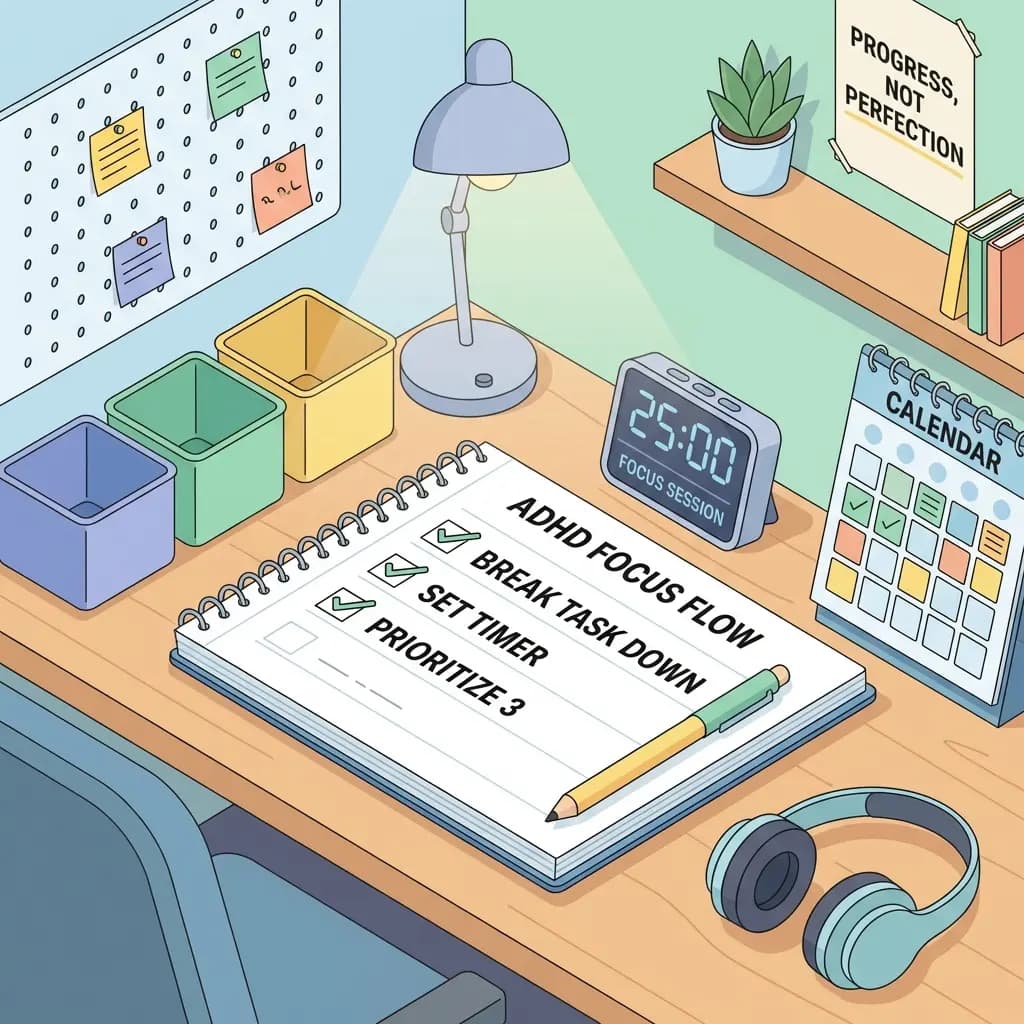
In therapy, you'll work on rebuilding your "pathways." You'll learn the Pomodoro technique, digital calendar organization, and safe ways to externalize memory (giant whiteboards, physical notebooks, phone alarms).
Everyday Hacks and Strategies (Bottom-of-Funnel Support)
Medication fixes the brain chemistry, but pills don't teach you to fish if you don't have the right tools at the riverbank. It's essential to learn the tricks to beat everyday paralysis. Among the gold-standard methods:
- The Two-Minute Rule: literally, if something takes "2 little minutes," do it right now. Don't schedule it. Putting a cup in the sink takes 30 seconds. Reply to that short email. Stacked-up small tasks are the perfect breeding ground for paralysis.
- Body Doubling: it's scientifically proven that ADHD brains perform up to 50% better with company present, even virtually. Hop on a Zoom call with a friend, even in silence with your screen minimized. It triggers a sense of social accountability that helps you focus and work.
- Positive Stress Visualization: vividly imagine your boss or coworker asking about that thing you've been putting off. The small hit of simulated adrenaline can be enough to unstick your frontal lobe into action.
Apps and AI to Take Back Control (Your New Tool)
Know that feeling when physical papers and to-do lists pile up and turn into visual clutter your brain has already learned to hate? The way to keep your treatment going at your own pace is leaning into AI tools built specifically to work around Executive Dysfunction.
And that's exactly where Lumi fits into your life.
If you feel stuck, with no energy to organize your task list alone because everything feels like a monumental block... why push through it alone?
Lumi acts as your permanent "Cognitive Coach and Body Double" right inside your phone.
- Breaking down huge tasks: when the mountain feels too tall, open Lumi and send a desperate voice message: "I can't make myself clean the whole living room, and I need it ready for the party tomorrow." The AI knows how to work with ADHD — it'll gently process the request and break that overwhelming mess into 5 painless micro-goals. Like: "Let's set a 3-minute timer on the living room floor. Get up, pick up the socks on the ground, and check back in with me. Let's go!" That kind of guidance disarms the paralysis perfectly.
- A safe, judgment-free ear: RSD often turns a silly mistake at work into a full-blown storm in your head. Talking to friends can feel embarrassing because they won't quite get it ("come on, it's fine, let it go!"). Lumi uses CBT-based techniques to help release that emotional weight without anyone giving you that analytical look.
Accepting your biological wiring is the foundation for everything you build from here. Neurodivergence also brings tremendous empathy and wild creative power when you're focused.
Build your support structures. See a psychiatrist. Unload your smaller everyday pile-ups on tools like Lumi.
Once you adopt these strategies, the fog lifts — and you're reminded, and finally proven right, that there's enormous potential in you, waiting to be used with room to spare.